8 COUNTRIES. 3 CONTINENTS. ONE SCRIPT THE INDUSTRY KEEPS ADVANCING.

Wild Woman
of the Woods

Thrown from a cliff at birth, she survived.
Now the mother who cast her away — the most feared chieftainess on the coast — will kill her to take what she carries: a Soul Catcher, and the only power that might stop a plague built to erase their people.

Open to the Right Production & Financing Partners
The Film

A Spanish schooner anchors off the Northwest Coast. Totem poles line the beach. War canoes ride the tide. A chieftainess gives birth — and throws her baby from a cliff.

That child is Neshekai.

The Wild Woman of the Woods saves her. Neshekai grows up with no clan, no crest, no name worth speaking. But she carries a Soul Catcher — a shamanic relic that finds lost souls and brings them home. She barely understands its power. Others will kill to control it.

A ceremony goes wrong. They cast her out. She finds Zugwa — a shaman, half-mad and magnificent, the last keeper of the old ways. His warning is simple. Someone is trapping souls. Spreading sickness. Erasing a world. To stop it, she must find the White Eagle — the one medicine that can save them all.

She crosses open ocean and ancient inlets. Haunted forests. Smallpox villages. Trading posts thick with whiskey runners. Then the truth finds her.

Her mother.

The one spreading the sickness. The one hunting her. The most powerful chieftainess on the coast.

Now Neshekai chooses. Stop her mother and lose the only love she has ever longed for. Or inherit the darkness that has hunted her since birth.

Some stories aren't told.They return.

Hollywood keeps proving the audience is there.

The Revenant — a brutal, near-wordless historical epic — earned over $530 million worldwide against a $135 million budget. Killers of the Flower Moon drew 10 Academy Award nominations, including the first-ever Best Actress nomination for a Native American performer.

Both were period pieces. Both were drawn from real history. Both were called uncommercial before they proved otherwise.

Wild Woman of the Woods is the epic neither of them told — an Indigenous woman's story, at that scale, on her own terms.

Wild Woman of the Woods is a mythic historical epic of the 19th-century Northwest Coast.

REQUEST THE SCRIPT
Available to industry professionals upon request.
Northwest Coast — sea stacks in fog
The Heroine
Neshekai

Cast out at birth. Raised on the margins. Forced to fight.

Neshekai is the girl no one claimed — and the woman no one can stop. Fierce, reckless, and dangerous when cornered, she will cross the coast, the wild, and the edge of empire to save the people she loves.

She was never given a place in the world. She means to take one.

Neshekai is one of the great unwritten roles for an Indigenous actress — a lead built to carry an epic, not decorate one. Fierce, wounded, dangerous, tender. She is not a symbol or a supporting presence in someone else's story. She is the center of this one.

REQUEST THE SCRIPT
Available to industry professionals upon request.
The Soul Catcher
Soul Catcher — Northwest Coast shamanic relic

An ancient shamanic relic, carved from bone and inlaid with abalone — used to find lost souls and bring them home. Or set them free. Neshekai carries one before she fully understands its power.

The World
Map of the Northwest Coast nations and coastline
The nations and coastline that shape the story.

The rivers were highways. The fishing grounds were owned. The hunting territories were inherited. Every death required a reckoning. Every peace required ceremony.

This was not wilderness.

This was a civilization — fully formed, with courts and commerce and hereditary governance and law in its bones.

Sea captains wrote home about their frustration. The Northwest Coast tribes outmaneuvered them at every turn. Their laws were strong. Their leaders were sharp. Their societies held.

That's not mythology. That's the colonial record.

1862 is the last year this world is entirely itself. That year, smallpox came to the coast. Vaccines existed. They were withheld. The infected ships were not quarantined, and the sick were driven out to die. Within months, half the villages stood empty.

This was not a natural disaster. It was policy.

Northwest Coast village — totem poles and war canoes
For thirty years, Hollywood has circled this world from the outside — and audiences came every time. The view from inside it has never reached the screen. That film has not been made. Not yet.
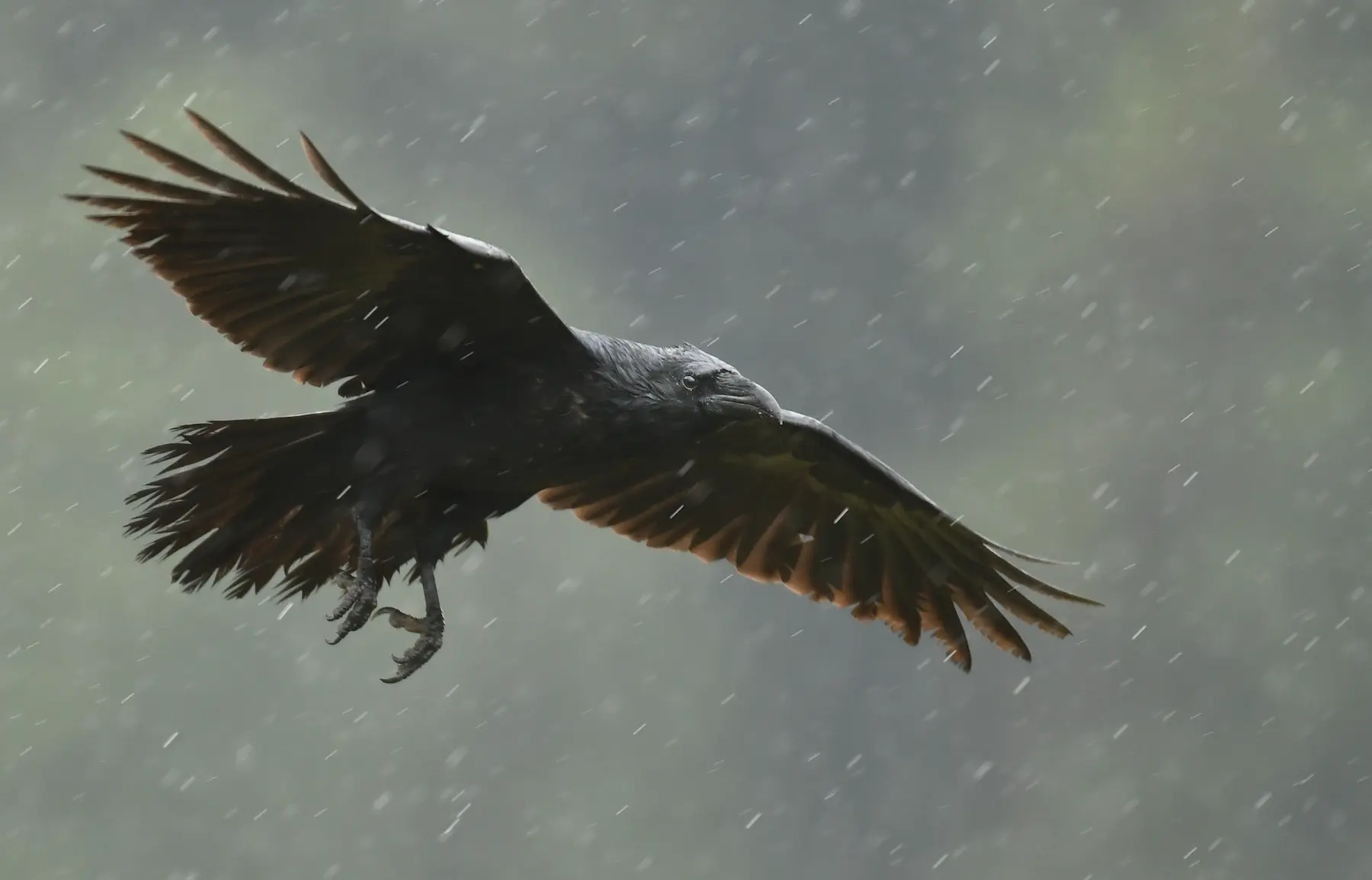
Raven in rain
"When a covenant is broken, it doesn't fall backwards — it falls into the ones not yet born."— from the screenplay

The world is built. The story is ready.

REQUEST THE SCRIPT
Available to industry professionals upon request.
Recognition

Contest judges are not casual readers. They are working development executives, produced writers, festival programmers, and industry analysts — paid to be ruthless, trained to say no.

Over the past year, Wild Woman of the Woods has been read and judged in competitions across eight countries and three continents. The verdict has been consistent.

This is not goodwill. It is market research — conducted by the industry, at no cost to the production.

— United States —
WorldFest-Houston International Film Festival
Silver Remi Award · Long Script · 2026
Austin Film Festival
Pitch Competition Winner · 2025
Austin Film Festival
Second Rounder · Top 20% of 11,000+ Scripts · 2025
Flickers' Rhode Island International Film Festival
Finalist · Oscar-Qualifying · 2025
Santa Barbara Screenplay Awards
Award Winner · Diverse Writers · 2025
ISA Diversity Initiative
Finalist · Top 100 of 3,500+ Scripts · 2026
— Canada —
Montreal Women Film Festival
Award Winner · 2026
The Writers Lab Canada
Bold Voice Award · 2025
— United Kingdom —
Global INDIE Filmmaker Awards
Award Winner · 2025
London International Screenplay Awards
Finalist · Feature Screenplay · 2026
— Germany —
Berlin International Screenwriting Festival
Finalist · Best Historical Screenplay · 2026
— Russia —
"BRIDGES" International Film Festival
Official Selection · St. Petersburg · 2026
— Japan —
Tokyo Women Film Festival
Semi-Finalist · Best Screenplay · 2026
— Switzerland —
Alpine International Film Festival
Official Selection · 2025
— Iceland —
The Whale Screenwriting Lab
Honorable Mention · 2026

London. Tokyo. St. Petersburg. Montréal. Different languages, different markets, different cinematic traditions — and the script crossed all of them. The world of this film travels.

You found it early. The question is what you do about that.

REQUEST THE SCRIPT
Available to qualified industry professionals upon request.
The Verdict

These are not website opinions. They are judgments from produced filmmakers, working agents, and contest judges who read the full script.

"This world has never been shown — and it deserves to be."

"You made me feel something deeply, and that's hard to do."

"I'd go see this movie without hesitation."

Austin Film Festival Pitch Competition Judges · 2025

"This is the kind of voice-driven epic people say they want and rarely get."

Santa Barbara Screenplay Awards · Professional Analysis

"It has the potential to become a landmark film — poetic, political, and unforgettable."

Judge ML, PAGE International Screenwriting Awards

"This isn't your typical historical drama — it's something far more dangerous and essential."

Jason Piette, BAFTA-Winning Producer · Disrupting Influence

"The Indigenous background feels completely authentic and respectfully drawn."

Joe Haar, WME

"This reads like a writer who knows exactly what they are doing and why."

Santa Barbara Screenplay Awards · Professional Analysis

Industry readers have delivered their verdict across three continents.

REQUEST THE SCRIPT
Available to qualified producers, directors, and financiers upon request.
The Writer

Tobi Iverson is a Tsimshian, Nisga'a screenwriter and cultural producer — and the great-great-granddaughter of Arthur Wellington Clah, the only known Indigenous diarist of the 1862 Northwest Coast smallpox epidemic.

She did not come to this story secondhand. Iverson holds a degree in Anthropology and American Indian Studies from the University of Washington and served as a National Park Service ranger at Sitka National Historical Park. For years she has studied the history, mythology, and material culture of the Northwest Coast — handling pre-contact objects in the Bill Holm Center archives at the Burke Museum, and traveling to London to read Clah's original journals at the Wellcome Collection, which has held them for over a century.

Clah wrote in hard-won English for fifty years, repeating one vow across journal after journal:

'writed by him to let all new people know about old People'

His journals — a public historical record for more than a hundred years — are the source and inspiration for this screenplay: an original work of fiction Iverson wrote, drawing on her own research, scholarship, and lifelong connection to this world.

She is an Artist Trust Fellow (2026) and is represented by entertainment counsel Caitlin DiMotta of Troy Gould PC.

This is not an outsider imagining an Indigenous world. This is an Indigenous woman returning to one — with the training to understand it and the craft to bring it to the screen.

REQUEST THE SCRIPT
Available to industry professionals upon request.
Tobi Iverson — Writer
The Writer
Screenwriter and Cultural Producer
Artist Trust Fellow — 2026
Great-Great-Granddaughter of Arthur Wellington Clah
University of Washington
Anthropology & American Indian Studies
ENTERTAINMENT COUNSEL: CAITLIN DIMOTTA, TROY GOULD PC
Tsimshian  ·  Nisga'a  ·  Killer Whale Clan
Turtle Mountain Chippewa
Creative Approach

This story is carried, not claimed.

Iverson writes from inside a living culture — one she loves, has studied, and shares with the community still carrying it forward. Her work is shaped by the artists, the ceremony holders, the knowledge keepers, and the people who hold this world today. She does not stand above that world. She stands within it, in unison with the people who keep it.

What she brings is not sole authority. It is devotion — the same love for this history and culture that her community carries, turned toward the screen so the world can feel it too.

That is what makes the work true. And it is what no production can manufacture from the outside: a story told with its people, not about them.

The Journey
London · 2023
Wellcome Collection.
Arthur Wellington Clah's journals.

Sixty-nine volumes. Fifty years of daily writing. 650,000 words in a language he taught himself in two months.

He capsized in the Skeena in January. Ice an inch thick. Half an hour in a freezing river. He swam to shore. He wrote it down. Then he kept going.

When smallpox reached Fort Simpson in 1862 — the epidemic at the heart of this film — Clah counted the dead himself. 363 Tsimshian. 266 at Fort Simpson alone. He wrote every number down.

He wrote his mission across every journal: 'writed by him to let all new people know about old People.' The only known Indigenous account of the 1862 Northwest Coast smallpox epidemic — written by Tobi Iverson's great-great-grandfather.

When Iverson touched those pages in London, she knew she had to finish the screenplay.

Arthur Wellington Clah's journals at the Wellcome Collection, London
His journals. Her hands. The Wellcome Collection, London.
Seattle · 2026
Burke Museum.
Bill Holm Center — Connections to Culture.

Selected to study the Northwest Coast collection. Two days in the archives with objects dating to pre-contact — bentwood boxes, Chilkat robes, raven rattles, masks from the Nass River.

One box stopped her. Pre-contact. No lid. Lost somewhere across two centuries. A hole in the corner from a mouse.

She put her gloves on. She put her hands on it anyway.

Clah knew boxes like this. He may have known this one. Nobody will ever know. But this is the research that cannot be replicated — because it is also inheritance.

The Obligation.
"If he could do that, I can finish a screenplay. That's not inspiration. That's obligation. The good kind."

Iverson is a direct descendant of Arthur Wellington Clah. She came to this material gradually — through archival research, family history, and reconnecting with the culture and history of the Northwest Coast. What she found was a great-great-grandfather who wrote against all odds for fifty years, in a language he taught himself, so that someone like her might one day find it.

To not follow that record would be its own kind of erasure.

That's why this film exists.

Indigenous girls on the Skeena River, 1800s
Skeena River. Northwest Coast.
Contact

This is a complete story. A world never shown at the scale it deserves.

Film does what nothing else can. It puts you inside a world you've never entered. Apocalypto. The Last of the Mohicans. You lived somewhere you'd never been.

The Northwest Coast has never reached the screen at that level.

Totem poles born on this coast, long before the world saw them. Clans inherited through the matriarchs — Killer Whale, Raven, Wolf, Eagle. Canoe journeys of thousands of miles in a single year. Cedar woven tight enough to hold water. Songs older than contact, still sung today.

This is a living culture. Most of the world has never seen it.

The film asks for a history-maker. A filmmaker who grasps the opportunity and the responsibility. An ally to bring this world to the screen — from the inside.

An introduction this culture has waited generations to make.

If you're that filmmaker, the screenplay is finished.

REQUEST THE SCRIPT
Entertainment CounselCaitlin DiMotta
Troy Gould PC
Map of the Northwest Coast — full size
Arthur Wellington Clah's journals at the Wellcome Collection, London — full size